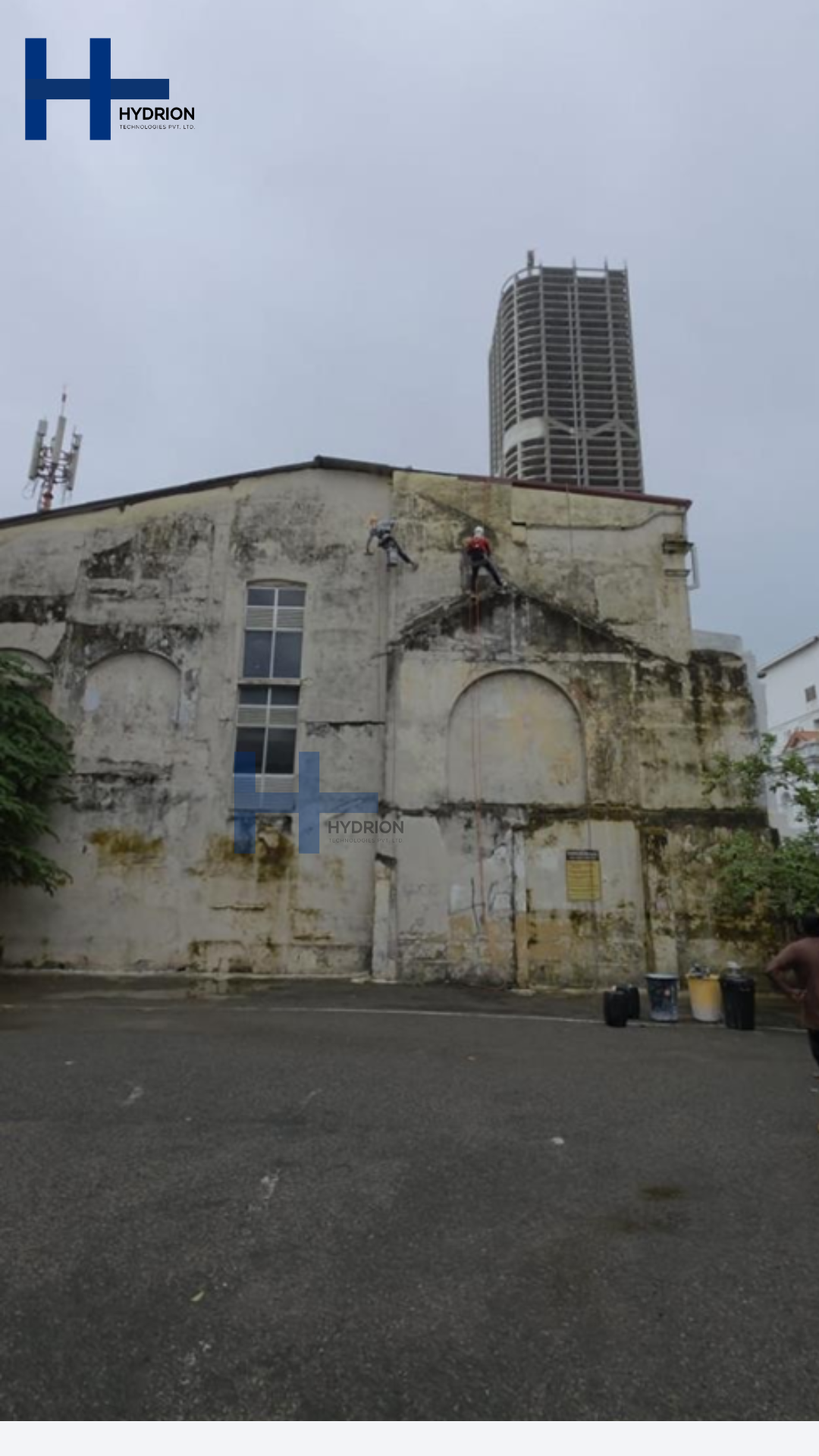
Heritage Vertical Wall Waterproofing
Rope-access restoration of a 100+ year-old heritage building using Hydrion's H-I BOND application and a disciplined two-stage waterproofing treatment.
Protecting a century-old facade without compromising its character.
This heritage building, more than a century old, presented a vertical wall facade with no practical scaffolding access and significant surface deterioration caused by age, moisture ingress, fungal growth and corrosion.
Hydrion Technologies was engaged for heritage vertical wall waterproofing using our HYDRO TECH RESIN system with H-I BOND application. The objective was to restore the wall's integrity and strengthen its resistance to water ingress while respecting the character and condition of the original structure.
A facade where conventional methods were not enough.
No conventional access
The building's height and heritage structure made standard scaffolding impractical, requiring a specialised access solution for the full vertical facade.
Severe surface conditions
Extensive fungal growth and isolated corrosion zones created conditions that could compromise the initial chemical bond if they were not properly addressed.
Fragile original plaster
The age of the substrate demanded additional care. Treatment had to protect the wall without unnecessarily disturbing plaster that had remained in place for generations.
Access, preparation and treatment — handled as one system.
Rope-access method
With scaffolding impractical, Hydrion deployed rope-access technicians to reach the full height of the wall safely and efficiently. This allowed treatment across the vertical surface without placing unnecessary physical burden on the historic structure below.
Surface preparation and chemical application
During application, the team identified pockets where fungal growth and corrosion were more severe than the initial survey indicated. Rather than proceed with a compromised bond, those zones were revisited and the chemical treatment re-applied to support proper penetration and adhesion.
Ionic treatment
Once the base treatment had cured, Hydrion carried out the Stage 2 ionic treatment across the facade to reinforce long-term protection against future water ingress and corrosion.
A customer-first response when the substrate revealed more.
During the Stage 2 ionic treatment, the team observed that sections of the century-old plaster had begun to lift and detach. This was identified as a pre-existing condition of the aged substrate rather than an effect of the waterproofing application.
Hydrion reported the issue transparently instead of treating over an unstable surface. The client then completed plaster repairs in the affected areas at their own cost.
Once the substrate was sound again, Hydrion returned and re-applied the ionic treatment to those repaired sections at no additional charge to the client, helping maintain a consistent treatment standard across the facade.
A reference case for technically demanding heritage waterproofing.
The project demonstrates how access strategy, substrate judgment and treatment discipline all contribute to the final waterproofing outcome.
Specialist access capability
Demonstrates Hydrion's ability to work on complex, access-restricted heritage structures using rope-access techniques.
Technical discipline
Compromised zones were re-treated instead of being accepted as a partial result, keeping the focus on application quality.
Customer-first response
After client-side plaster repairs, Hydrion returned to re-treat the affected sections at no additional charge to the client.
Relevant heritage reference
A useful proof point for institutional and heritage-property clients looking for technical rigour, transparency and reliability.
Have a difficult facade or access-restricted waterproofing project?
Talk to Hydrion about the condition of your structure and arrange a site assessment with our team.
Request a Free Assessment →